1. Early/Ancient History:
Palestinians have lived in the region of Palestine (located in the Southern Levant region in the Middle East) for thousands of years — their roots trace back to the ancient Canaanites, who inhabited the land as early as 3000 BCE or earlier (about 5,000 TO 10,000 years or more). This is before ancient Jews crossed over and invaded the land (known as Canaan in those times, and “Peleset” i.e. Palestine, in ancient Egyptian times) from Egypt (according to biblical stories), killing Canaanite tribes. It is also before the advent and spread of religions like Christianity and Islam in the region.
Over millennia, the population evolved through various cultural, religious, and political changes, including periods of Egyptian, Assyrian, Babylonian, Persian, Greek, Roman, Byzantine, Islamic, Ottoman, and British rule.
As a result, the region’s people experienced religious conversions and diverse ethnic and cultural influences, shaping the identity of those known today as the Palestinian people.
The modern Palestinian identity — as an Arab people native to the region of Palestine — began to solidify more distinctly in the 19th and early 20th centuries, especially in response to colonialism and Zionist settlement under the Ottoman Empire and British Mandate.
For 400 years, Palestine was part of the Ottoman Empire, a vast empire that ruled much of the Middle East. During this period, Palestine was a multi-ethnic and multi-religious society with Muslims, Christians, and Jews living together relatively peacefully.
Palestinians therefore have ancestral ties to the land of Palestine going back thousands of years, with a continuous presence and cultural development in the region long before any ancient Jewish presence and before the modern state of Israel was established in 1948.
Historic Palestine is located in the Southern Levant in the Middle East, encompassing modern-day ‘Israel,’ the West Bank, and the Gaza strip.
2. Zionism and the Colonization of Palestine
The colonization of Palestine involved multiple waves of Jewish migration followed by political and military actions against the indigenous Palestinian population upon the formation of the state of Israel.
Zionism (late 1800s): Zionism, a political nationalist movement, emerged in the late 19th century in Europe. The goal of the movement was to establish a Jewish homeland in Palestine in the face of increasing anti-Semitism in Europe, particularly in Eastern Europe and Russia. This led to the first waves of Jewish immigration to Palestine (1882–1903). Tensions began to rise between Jewish settlers and the indigenous Palestinian Arab population as settlers began encroaching on their homes and land.
There were other places being considered for a Jewish homeland, including Uganda and Argentina, but Zionist leaders settled on Palestine for its historic significance to Jews. Case in point, Palestine also has historic significance to Christians (as the home of Bethlehem) and Muslims (Al-Aqsa mosque).
Zionist leaders marketed Palestine as ‘a land without a people, for a people without a land.’ This was a false claim, as Palestine has been the historic and ancestral homeland of the Palestinian people for thousands of years.
Below is a breakdown of key phases in the colonization and occupation of Palestine.
Videos about the history of Palestine:
QUOTES FROM KEY EARLY ZIONIST LEADERS ON THE SETTLER-COLONIAL PROJECT OF ISRAEL
Here are some quotes from prominent Zionist leaders, illustrating their perspectives on colonization and the creation of a Jewish homeland in Palestine by expelling the native Palestinian Arab population. In typical colonizer fashion, they branded the native population as savages and animals who had to be removed for their colonial aspirations.
Theodor Herzl (1860–1904)
The father of political Zionism, Herzl was pragmatic about the need for a Jewish homeland in Palestine and openly discussed colonial tactics.
- “We shall try to spirit the penniless population across the border by procuring employment for it in the transit countries, while denying it any employment in our own country… The process of expropriation and the removal of the poor must be carried out discreetly and circumspectly.”
– The Complete Diaries of Theodor Herzl (1960) - “Supposing we were obliged to clear a country of wild beasts, we should not recoil from the necessary means… The same applies to people in the case in point.”
– The Complete Diaries of Theodor Herzl (1960)
Ze’ev Jabotinsky (1880–1940)
Jabotinsky, a founder of Revisionist Zionism, was more openly militant in his colonial ambitions. He promoted the idea that an “iron wall” of Jewish military strength was essential for the establishment and maintenance of a Jewish state.
- “We cannot give any compensation for Palestine, neither to the Palestinians nor to other Arabs… Zionism is a colonization adventure and therefore it stands or falls by the question of armed force.”
– The Iron Wall (1923) - “Zionist colonization must either stop, or else proceed regardless of the native population. Which means that it can proceed and develop only under the protection of a force that is independent of the local population— an iron wall which the native population cannot break through.”
– The Iron Wall (1923)
David Ben-Gurion (1886–1973)
Ben-Gurion, Israel’s first Prime Minister, was a central figure in establishing Jewish settlements and believed in a pragmatic approach to securing land for a future Jewish state.
- “We will expel the Arabs and take their places… In each attack, a decisive blow should be struck, resulting in the destruction of homes and the expulsion of the population.”
– A letter to his son, 1937 - “If I knew that it was possible to save all the children of Germany by bringing them over to England, and only half of them by transporting them to Eretz Israel, then I would opt for the second solution.”
– Ben-Gurion’s diary, 1938 - “We must expel Arabs and take their places… and, if we have to use force— not to dispossess the Arabs of the Negev and Transjordan, but to guarantee our own right to settle there.”
– A letter to his son Amos, 1937
Chaim Weizmann (1874–1952)
Chaim Weizmann, who was instrumental in securing the Balfour Declaration (1917 – see next section), frequently discussed the need for a Jewish state in Palestine in colonial terms, often justifying the project as one with European backing and support.
- “The British told us that there are some hundred thousand negroes [Palestinian Arabs] and for those there is no value.”
– Quoted in Tom Segev’s One Palestine, Complete: Jews and Arabs Under the British Mandate (2000) - “Palestine shall be as Jewish as England is English.”
– Quoted in Israel: A History by Martin Gilbert
3. British Mandate Period (1917–1948)
Balfour Declaration (1917): During World War I, the British government issued the Balfour Declaration, which expressed support for the establishment of a “national home for the Jewish people” in Palestine. This was seen as a diplomatic move to gain Jewish support for the war effort but ignited tensions between Jews and Arabs in the region.
British Mandate of Palestine (1920–1948): After the war, Britain was given control over Palestine by the League of Nations. The British Mandate period saw increased Jewish immigration, especially as Jews fled rising anti-Semitism in Europe and, later, the Holocaust. As a colonial power, Britain had no rightful authority to engage in discussions about giving away the land of the native Palestinians, let alone to grant it to others.
Zionist Militias (1920-1948): Early Zionist militias in Palestine, including the Haganah, Irgun, and Lehi (Stern Gang), were instrumental in securing Jewish control over the region before and during the establishment of Israel. These militias conducted operations to enforce and uphold Jewish settlements and also included attacks on British and Palestinian targets. The Haganah adopted aggressive tactics, as seen in “Plan Dalet,” which aimed to secure territory by displacing Palestinians. Irgun and Lehi took even more extreme measures, such as the King David Hotel bombing and the Deir Yassin massacre, which intensified Palestinian displacement. In 1948, these militias merged into the Israel Defense Forces (IDF), cementing their legacy in Israeli statehood through the continued mass displacement and colonial violence against Palestinians.
As part of the dozens of attacks on Palestinian villages, the Deir Yassin massacre was a pivotal and tragic event that took place on April 9, 1948, in the Palestinian village of Deir Yassin, near Jerusalem. Armed Zionist militias, primarily the Irgun and Lehi (Stern Gang), attacked the village as part of a broader campaign aimed at securing key areas and creating a contiguous Jewish territory before the end of the British Mandate in Palestine.
Arab Revolts (1936–1939): As Jewish immigration and settlement accelerated, Palestinian Arabs began to resist. The Arab Revolt was a series of uprisings against British rule and Jewish immigration. The British cracked down harshly, and tensions between Jews, Arabs, and the British continued to escalate.
ALBERT EINSTEIN OPPOSED THE CREATION OF ISRAEL AND CALLED OUT JEWISH TERRORIST MILITIAS
Renowned German Jewish scientist Albert Einstein was a vocal critic of the political movement behind the establishment of Israel, and was against the creation of a Jewish state. He feared that a Jewish state with nationalistic and militaristic foundations would lead to ongoing conflict with the Arab world and undermine Jewish ethical values. He also rejected the presidency of Israel when it was created in 1948, citing a lack of political experience.
“I am in favor of Palestine being developed as a Jewish Homeland but not as a separate State. It seems to me a matter for simple common sense that we cannot ask to be given the political rule over Palestine where two thirds of the population are not Jewish.”
Typed Letter Signed (“A. Einstein”), 1 page, quarto, on his personal embossed letterhead, 112 Mercer Street, Princeton, New Jersey, January 21, 1946. To Henry J. Factor in Indianapolis.
In 1948, Einstein co-signed a letter (see letter below) with prominent intellectuals to the New York Times condemning Menachem Begin and his Herut party (the precursor to Likud, the party that current Israeli prime minister Benjamin Netanyahu leads), which he described as a “terrorist” group responsible for violent acts against Arabs and British forces, particularly after the Deir Yassin massacre. The letter called Begin’s policies “fascist” and warned Americans about supporting his leadership in Israel.
“When a real and final catastrophe should befall us in Palestine the first responsible for it would be the British and the second responsible for it the Terrorist organizations build up from our own ranks. I am not willing to see anybody associated with those misled and criminal people.”
— original letter (below) which Einstein wrote in 1948 to Shepard Rifkin, the Executive Director of American Friends of the Fighters for the Freedom of Israel and a representative of the Stern Group based in New York.
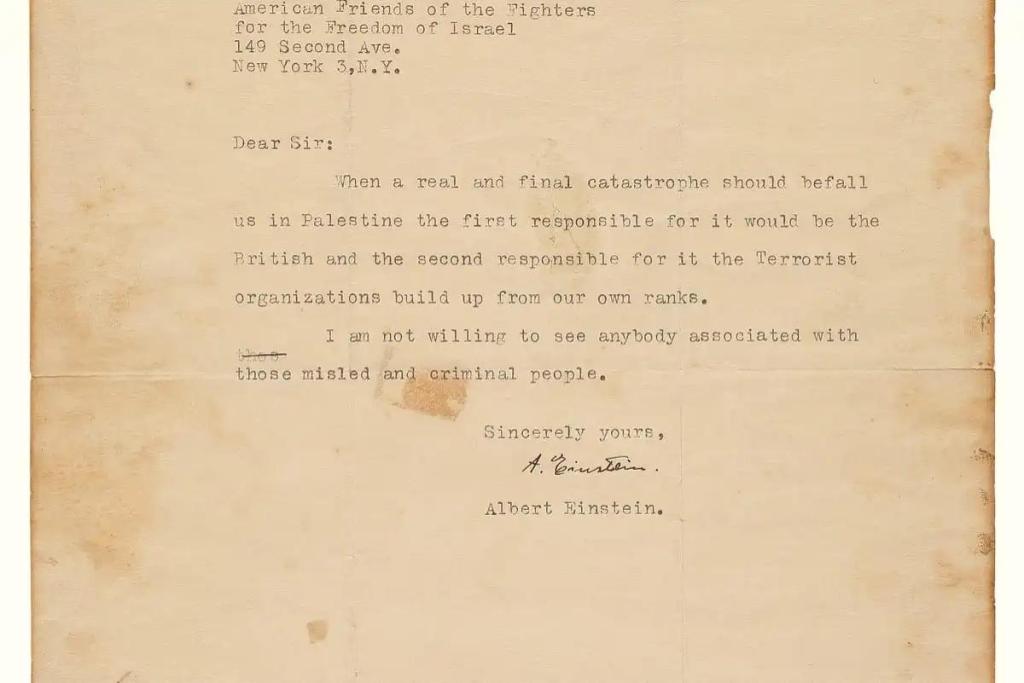
The American Friends of the Fighters for the Freedom of Israel group was initially established to promote the anti-British agenda of the Stern Gang and to raise funds in America for purchasing weapons to expel the British from Palestine. The gang also began attacking the native Palestinian Arab population, which Einstein called out.
4. Partition and the Creation of Israel (1947–1948)
UN Partition Plan (1947): In response to growing conflict, the United Nations (UN) proposed a partition of Palestine into two states, one Jewish and one Arab, with Jerusalem as an international city. The Jewish leadership accepted the plan, but Arab leaders rejected it, as they had not been consulted and it unfairly favored the Jewish minority, who made up less than a third of the population.
1948 Arab-Israeli War: In 1948, when the British mandate ended, the Jewish community declared the creation of the State of Israel. This immediately led to a war between the newly declared state and neighbouring Arab countries. The war led to the displacement of hundreds of thousands of Palestinian Arabs, who became refugees in neighbouring countries. This event is known as the Nakba (translates to ‘catastrophe’ in English). Watch the video below for more on the Nakba.
5. Post-1948 Period: Occupation and Settlements
1949–1967: After the 1948 war, Israel controlled more territory than what had been allocated by the UN partition plan. Jordan annexed the West Bank, and Egypt took control of Gaza. Palestinians continued to live in these areas, often as refugees, with no state of their own.
Six-Day War (1967): In 1967, Israel fought a pre-emptive Six-Day War against neighboring Arab states and gained illegal control, in violation of the UN’s Geneva Conventions, of the West Bank, Gaza Strip, East Jerusalem, and the Golan Heights. This began the Israeli occupation of these territories, which continues to this day.
According to customary international law, as reaffirmed by UN resolutions and the International Court of Justice (ICJ), acquiring territory by war is inadmissible. This principle was emphasized in UN Security Council Resolution 242 (1967), which called for the withdrawal of Israeli forces from territories occupied in the 1967 conflict and underscored the inadmissibility of territory acquisition by war.
Israeli Settlements: Following the 1967 war, Israeli settlements began to be established in the West Bank and Gaza. These settlements, which are illegal under international law, expanded over the decades. The settlement project is part of a broader colonization strategy and Israel’s goal of creating a ‘Greater Israel’ that encompasses other countries including Lebanon, Syria, and Yemen.
6. Intifadas and the Peace Process (1987–present)
First Intifada (1987–1993): The First Intifada was a mass Palestinian uprising against Israeli occupation, marked by civil disobedience, protests, and violent clashes initiated by the Israeli government. It led to increased international attention and eventually to the Oslo Accords (1993), which were supposed to create a framework for peace and the establishment of a Palestinian state.
Second Intifada (2000–2005): The peace process faltered, and a second uprising broke out in 2000. This Intifada was marked by more brutal Israeli military interventions and Palestinians, who as occupied people, exercised their right to armed resistance, as enshrined in international resolutions and law.
The United Nations General Assembly (UNGA) has affirmed the right of Palestinians to resist Israel’s military occupation, including through armed struggle, as part of their right to self-determination. Key resolutions, such as UNGA Resolution 3314 (1974) and UNGA Resolution 37/43 (1982), recognize the legitimacy of this struggle for independence from colonial and foreign domination.
Gaza Disengagement (2005): In 2005, Israel unilaterally withdrew from the Gaza Strip, dismantling its illegal settlements there. However, Israel has maintained a blockade on Gaza, controlling its land borders, airspace, and coast, for more than 17 years.
The Great March of Return (2018): The Great March of Return was a mass protest movement in Gaza that began in March 2018, where Palestinians gathered near the Gaza-Israel border to demand the right to return to lands from which they were displaced in 1948 and to call for an end to Israel’s blockade on Gaza. The event was peaceful until Israeli forces responded with live ammunition and tear gas, killing over 200 Palestinians and injuring thousands. Israel targeted healthcare workers, journalists, and even disabled people in its attacks.
7. The Ongoing Occupation and Settler Expansion
Current Situation: Today, Israel continues to control the West Bank through a combination of military occupation and settlement expansion.
The Gaza Strip is governed by Hamas, which took control after elections in 2006. The peace process has largely stalled, with periodic flare-ups of violence and ongoing settlement construction undermining the prospect of a two-state solution.
In October 2023, Israel launched its assault on Gaza after Hamas fighters attacked Israel on October 7 in order to take military personnel as hostages to strike a deal to release some of the thousands of Palestinian prisoners Israel has been holding hostage (most without charge) in its prisons. Israel claims it is targeting Hamas but it has been indiscriminately bombing Gaza, while targeting civilians and civilian infrastructure, constituting a genocide.
——————————————————————————-
Further Reading:
Edward W. Said. The Question of Palestine (Vintage, 1979).
Rashid Khalidi, The Hundred Years’ War on Palestine: A History of Settler Colonialism and Resistance, 1917–2017 (Metropolitan Books, 2020).
Ilan Pappé. The Ethnic Cleansing of Palestine (Oneworld Publications, 2007)
Benny Morris. The Birth of the Palestinian Refugee Problem, 1947–1949 (Cambridge University Press, 1987).
Norman Finkelstein. Gaza: An Inquest into Its Martyrdom (University of California Press, 2021).
Avi Shlaim. Three Worlds: Memoir of an Arab-Jew (Oneworld Publications, 2023).
Ghassan Kanafani. Men in the Sun and other Palestinian Stories (Lynn Rienner, 1999).
Susan Abulhawa. Mornings in Jenin (Bloomsbury, 2010).
Mahmoud Darwish. In the Presence of Absence, translated by Sinan Antoon (Archipelago Books, 2011).
MIko Peled. The General’s Son: Journey of an Israeli in Palestine (Just World Books, 2016).
Shlomo Sand. The Invention of the Land of Israel: From Holy Land to Homeland. Translated by Geremy Forman (Verso Books, 2012).
Edward S. Herman and Noam Chomsky. Manufacturing Consent: The Political Economy of the Mass Media (Pantheon Books, 1988).
Decolonize Palestine: https://decolonizepalestine.com/intro/palestine-throughout-history/
 Stop the Gaza Genocide
Leave a comment